Celebrating 126 Years of Serving the communities of Devine, Natalia, Lytle, Bigfoot, and Moore in Medina, Frio, and Atascosa Counties
Category: City & County Politics
Information you need to know about the City of Devine, Medina County Commissioner’s Court, City of Natalia, City of Lytle, and our local Emergency Service Districts.
Medina County Judge Chris Schuchart plaques and certificates honoring county employees for their service during the June 30 commissioners court meeting. In the foreground at left, Marla Winder receives special notice upon her retirement after 16 years of service. Foreground right, Jessica Medina, sheriff’s office dispatcher, and Joey Catina, sheriff’s deputy, get certificates for 10 years service. Two honored who were not present were Tony Agular, a sheriff’s deputy for 20 years, and Cindy Sandoval, sheriff’s office records clerk for 10 years.
By Anton Reicher The Medina County Commissioners Court spent the week leading to the Fourth of July conducting one regular meeting and two budget workshop sessions with a strong emphasis on law enforcement requirements. Making presentations to the court were Sheriff Randy Brown, District Attorney Mark Haby, County Court-at-Law Judge Mark Cashion, Precinct 2 Constable Jim Przybylski, Justice of the Peace Glenn Klaus, Juvenile Probation Officer Lynette Drury and pre-trial services administrator Dorothy Hastings. Commissioners also heard from county clerk Gina Champion, county auditor Eduardo Lopez, elections administrator Lupe Torres and veterans’ services officer Ruben Gonzalez and representatives of the county’s agricultural extension service office. Sheriff Brown addressed the court on his plans to increase jail revenue during the coming budget year. With the final completion of the jail addition and renovation project in January, the county expects an extra $375,000 in revenue to come from renting jail space to entities such as the U.S. Marshals Service. The expected revenue is calculated based on $55 a bed daily divided by two. “When we swing the doors open, we’re hoping to have enough jailers to handle it,” Brown said. Also discussed during Brown’s presentation was the delay in delivery of nine Chevrolet Tahoes ordered by the county for the sheriff’s office in October 2021. The delays are being blamed on COVID-19 pandemic supply chain issues. “I’m literally disgusted,” County Auditor Lopez said. Equipment needed to put eight of the nine vehicles in operating conditions arrived at the “upfitting” facility on June 29, he said. “They are telling me the ninth one is there but I can’t verify that,” Lopez said. The county has been notified that two other vehicles ordered, a Ford F250 and a Ford F150, may be so behind schedule that the trucks delivered will be 2023 models, not 2022 models. Unfortunately, these vehicles will be subject to any price increases for the newer models. “I have no idea what to expect on these vehicles,” Lopez said. “It’s a complete train wreck right now.” Lopez, in a separate presentation, asked commissioners for $67,500 to cover indirect costs from the move to consolidate the public defenders’ office for five counties to be based in Medina County. He also asked for the hiring of a new full-time employee to be split between his office and human resources to help with new increase in personnel that the completion of the jail project represents. Constable Przybylski presented his argument for a salary increase from $33,211 to $48,500, plus an increased travel allowance. He reported that since 2013 his office has made 2,937 traffic stops with 2,280 citations and arrest warrants served. In citations, the office has collected $320,000 since 2015 with nearly $34,000 in civil process fines collected together with the justice of the peace’s office in the same period. “We’re not just sitting there, running traffic and speed traps,” Przybylski said. District Attorney Haby told commissioners his budget included slight increases in various categories but “nothing shocking.” Those increases included raises in salaries for prosecutors. “Hiring and retaining skilled prosecutors in rural areas is a challenge,” Haby said, particularly when in close proximity to a large metropolitan county such as Bexar. A first assistant district attorney in Medina County makes just over $90,000 annually, Haby said. In Bexar County, the same position pays nearly $177,000. Juvenile probation officer Drury asked for an increase of $153,000 in her budget, calling the need “critical.” “The majority of it is going to placements and detention,” Drury said. “Those are going up significantly across the state.” Justice of the Peace Klaus asked to upgrade a part-time employee to help deal with the escalating number of drug cases filed in his jurisdiction. Aside from law enforcement issues, veterans’ services officer Gonzalez took the opportunity to recognize a recent success for his office, correcting a Veteran’s Administration error that allowed one client to recover $408,000 in unpaid health care benefits. During the regular court meeting on June 30, the commissioners heard a presentation from Mark Miller of Westwood County Engineering on the development of a master drainage plan for Medina County. Priorities for the plan are to identify risk, develop project concepts, develop funding goals and partnerships, develop mechanisms to increase drainage infrastructure funding and coordinate the project with state and federal agencies such as the Texas Water Development Board and the Texas Division of Emergency Management. In subdivision development news, the commissioners approved plans to vacate and replat Lot 20 in Holiday Villages located in Precinct 1 on County Road 151. No comments were heard during a public hearing on the request. The commissioners gave final approval on Desert Willow Acres and Hunters Ranch Unit 14A, both in Precinct 3. The court also approved the construction plan for Amanda Park in Precinct 2, permitting building to begin.
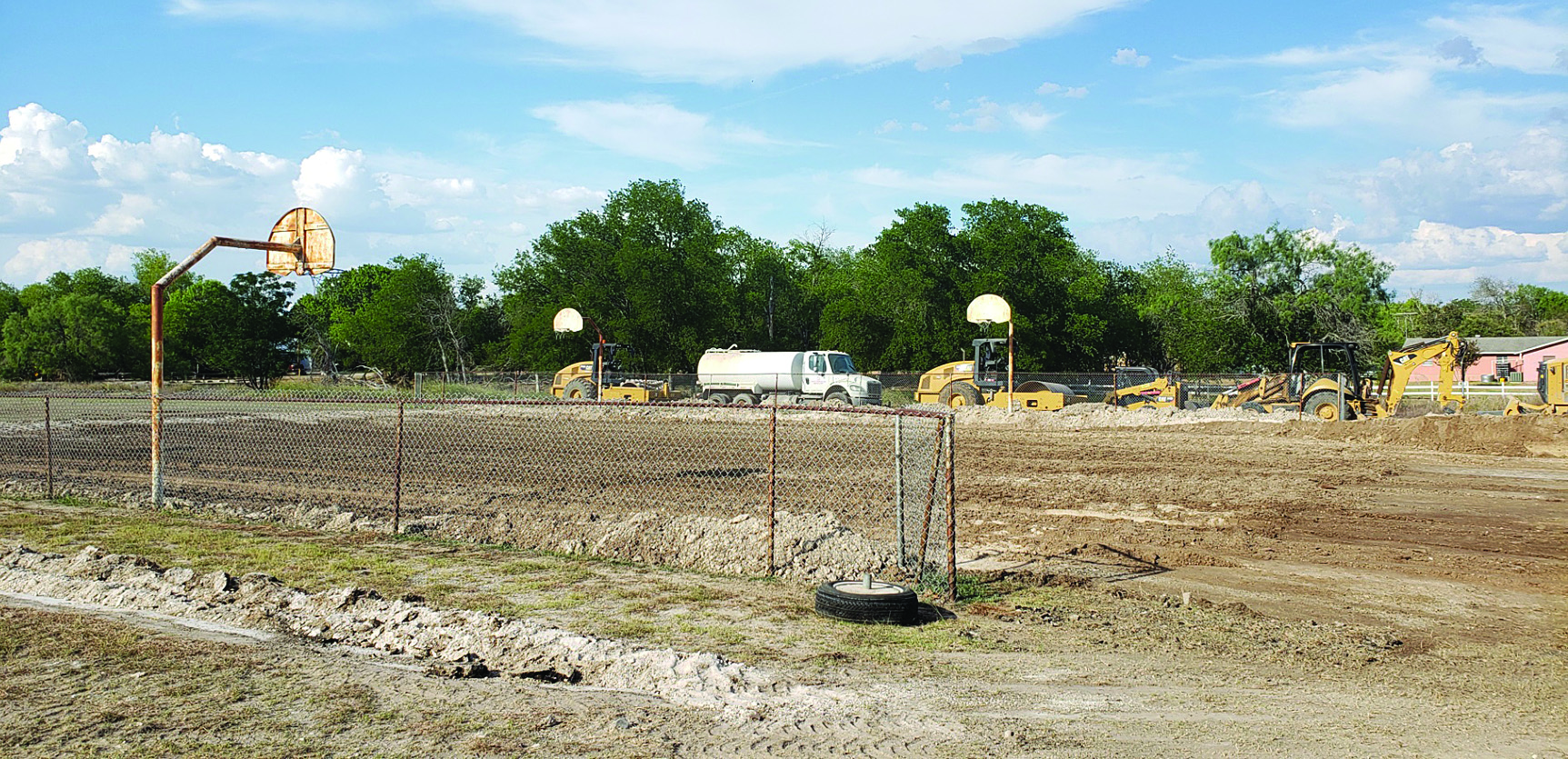
Construction ongoing at the basketball courts on Warhorse Drive. The large donation and rehab of these courts is exciting for the community and local families who will enjoy playing ball here for years to come.
At the June 20th school board meeting, the board approved the funding donated by DYSA to re-do the basketball courts across from the Intermediate School. A motion made by Chris Davis to approve the funding, seconded by Carl Brown, passed by vote of five to zero. The board also approved a $42,350 donation by the Devine Youth Sports Association to renovate a basketball court near the intermediate school. Donations to the district greater than $2,000 must be approved by the board. Work planned involves stripping off the old asphalt, adding curbing around the court and filling it with fresh asphalt. Future donations by the association would cover the cost of painting the court. “Quite a nice donation for them to take care of that basketball court,” board president Nancy Pepper said.
A seven-percent salary increase for Medina County Appraisal District employees to compensate for record inflation became a last minute addition to the preliminary 2022-23 budget approved by the district’s board of directors June 14. Before the additional salary increase, the preliminary budget stood at $1.553 million, an increase of nearly $100,000 more than the previous year. That budget included a five percent salary hike and funds for additional computer services. “We have to look at all the dollars but I think that’s just an area where we have to make that adjustment,” MCAD board chairman Tim Hardt said. “I think a five percent increase doesn’t even keep up with the cost of living.” State law required action on a preliminary budget by June 15, chief appraiser Johnette Dixon told the board. The board also discussed an increase in the vehicle allowance paid to the district’s eight appraisers who use their own vehicles. “Only a handful of appraisal districts actually pay mileage,” Dixon said. “The majority pay appraisers either a vehicle allowance or own their own vehicles for employees to use.”
According to the most recent audit reported for the previous fiscal year, Medina County’s fiscal year 2020-2021 budget had a new taxable appraised value of $3.83 Billion, an increase of $364 million (10.5%) from the previous fiscal year (2019-2020). This increase is mainly due to new properties and property values, according to the auditor. -Property taxes accounted for $22,196,235 Clarification to our June 1st article on county revenues: The audit presented to Medina County Commissioner’s court last month, for the year ending September 30, 2021, showed the following:
Medina County’s total revenues were over $36 million ($36,090,346). A breakdown of the revenues in the report titled “Statement of Revenues, Expenditures and Changes in Fund Balances of Governmental funds for the fiscal year ending in September 30, 2021” were categorized as follows: General $23,609,346 + Debt Service $2,390,479 + Certificates of Obligation $54,572 + American Rescue Plan Grants $583,314 + Other Govermental $9,452,635 = Total Governmental Fund Revenues $36,090,346. -The ending fund balance was $24,187, 241.
Highlights from Auditor’s financial analysis: Differences between the original budget and the final amended budget for fiscal year ending Sept 30, 201, can be summarized as follows: -Actual revenue exceeded budgeted revenue by $2.9 million -Actual revenues exceeded expenditures by $4.4 million
With agenda intended on streamlining city leadership roles, projects and procedures, the Lytle city council passed all but one tabled item during Monday night’s four and a half hour meeting.
Sheriff Randy Brown shares the realities of how deputies are already spread thin across our growing county.
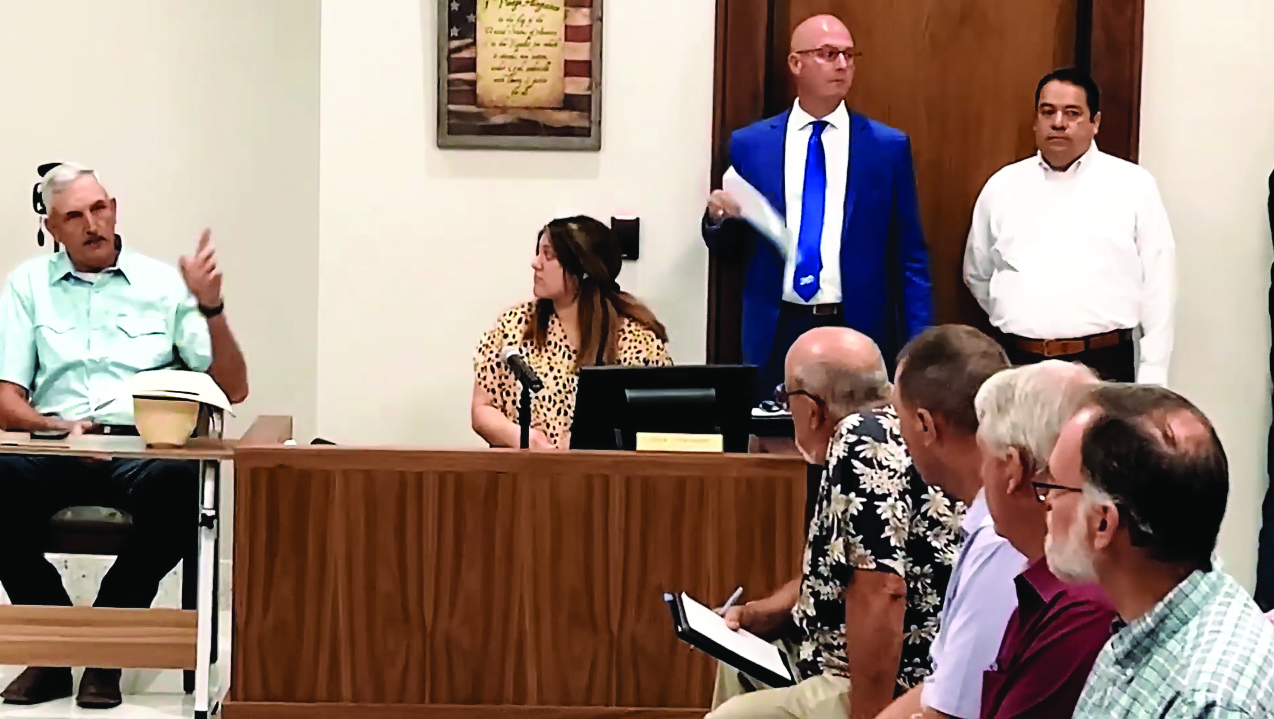
In the wake of the May 24 shooting massacre at Robb Elementary School in Uvalde that left 19 students and two teachers dead, administrators from the several Medina County school districts met with county commissioners to request funding for 1 additional school resource officer be assigned to every school district. Eric Smith, president of the Natalia school board, led the presentation made during a June 2 regular session of the commissioners’ court. “I will not throw out fancy stats or figures on school shootings in the U.S. or Uvalde,” Smith said. “I’m pretty sure each of us is aware and it makes us, including me, sick to our stomachs every time we turn on the news.” Also speaking for the gathered administrators was Shannon Beasley, vice president of the Medina Valley school board. “It touches us deeply and is what we as trustees and stewards of our students consider the worst nightmare,” Beasley said. David Lynch, precinct 2 commissioner, led the meeting in the absence of County Judge Chris Schuchart. He emphasized that the SRO request had been added to the court’s agenda solely as a matter of discussion. “This is not an action item,” he said. “We want to hear your concerns and maybe have a little dialogue.” “We are all products of Medina County schools,” Lynch added.” Our wives are products of Medina County schools. Our children, our grandchildren are too. So, we understand the need for security and safety as a foremost priority.” “Also we have been on the phone with Pete Flores and Andrew Murr, who said ‘We have State funding….funding that nobody ever asks for. So that may be another piece to this puzzle,” Lynch said. He said he was sure Judge Schuchart would want to be on hand for any final decision by the commissioners. Medina County Sheriff Randy Brown verified that the county at present has six SROs for the entire county, which are all placed at Medina Valley ISD schools. The cost to add a single new officer on board, including training and vehicle, could be nearly $130,000, he estimated. For seven, that’s a little under $1 million dollars ($910,000). “We need to stop calling them SROs,” Brown said. “They are not school resource officers. We need police in the schools that can do the job.” Even with immediate approval of such a hire, finding the right person to fill the role will be difficult, he said. “If we can figure out how to do this I support you 100 percent,” Brown said. “I don’t know where the money is going to come from but our greatest treasurers are in those school buildings.” “When I was driving back from Uvalde that night, I started checking into costs,” Sheriff Brown said. “We’ve got to do everything we can to make schools are safe as we can for everyone.” Sheriff stated that “With all the growth in the county, it’s just unbelievable the number of calls we have.” He noted that he would like to have 7 more deputies on staff. He also stated that in the future he would like to see deputies in schools countywide. “I don’t need somebody in the schools that calls us. I need somebody in the school that IS us. I know a lot of school districts have approached us and would like to have a deputy on campus.” “I guarantee you if something happens, we’ll be there. …It’s hard to say we are going to be there in 5 minutes though if we are all the way up on Hwy 16. Someday, I am going to have enough people to divide the county into 4 different quadrants,” he said in hopes that he can have deputies better positioned to help when an emergency arises. Towards the end of his speech, Sheriff Brown commented, “We can talk and talk and talk….but we need to stop talking and do something.” Sheriff Brown mentioned there is a COPS grant that has a deadline of June 9, but felt it may be too late for locals to apply. (see separate article) On hand from Devine ISD were superintendent Todd Grandjean, assistant high school principal Daryl Wendel, school board president Nancy Pepper, board member Ali Buvinghausen and financial resource officer Shannon Ramirez, Harry Piles of Natalia ISD. Board members from the various districts were also present. Superintendent Grandjean commented that Devine has instituted the Guardian program (which allows certain staff to carry a concealed weapon), and that regional training for other local districts is available. Smith opened his presentation with a detailed breakdown of the security presently available at schools throughout the county. “When you look at the six districts here today the largest is Medina Valley with over 7,500 children and eight different campuses, six of which have school resource officers paid for by Medina Valley ISD,” Smith said. Hondo ISD has one police officer funded by the school district and another locally funded through the city of Hondo, he said. Devine has one SRO officer who travels between all campuses as needed, and the expense is shared by the city, with a majority covered by the school. Like Devine, Hondo is part of the Texas School Guardian Program, an armed defensive approach to active shooters on campus. Although D’Hanis ISD also has the Guardian program, the district does not include an incorporated city and does not have a school resource officer. Natalia ISD has one police officer from city police but funded by the district. The district cut short its school year following a Natalia student being charged with terroristic threat. Lytle ISD has one Medina County sheriff’s deputy who is funded by the school district at a cost of $60,000 annually, Smith said. “I was happy when I reached out to those six districts that represent Medina County public schools educating 12,000 children and employing over 2,000 staff,” Smith said. “They were in full support of why I am here.” He noted that this was the second time he had made this request for his school district. “Several years ago I requested that you would consider looking into possibly giving some kind of tax reduction to offset appraisals that we know you do not control but to try and offset the cost,” Smith said. The decision at that time was not to go forward with a tax reduction scheme, he said. “I will not criticize the decision you make in regard to our (latest) request,” Smith said. “I would just ask that you remember 51,000 residents in our county that have 12,000 relatives attending these schools.” He added that what was being requested was not a luxury “but a necessity.” But, even at that, additional SROs “would not be an end-all solution and would not guarantee our children would not be in harm’s way.” Following Smith’s presentation, Beasley said Medina Valley ISD has had a strong focus on school safety since 2018. However, discussing in detail security measures in place is not in the best interest of the students. “Unfortunately, what the media portrays is often not the whole story,” Beasley said. “As any of us elected officials know often things happen that we can’t talk about.” Commissioners emphasized that the fund balance might look like an easy source of funding when things are going good. However, circumstances can change quickly. That healthy fund balance might make the difference between personnel layoffs or funding important projects, they noted. “We’re not saying no to anything but our fund balance and the shape that it is in is very important to the commissioners,” Lynch said. “Trying to meet your needs and desires without affecting that is something we’ll have to work through.” A one-time expense using the fund balance is one thing, he said. However, SRO officers are an ongoing expense. “That revenue flow is going to have to come from somewhere and it will be the taxpayers that fund that ultimately,” Lynch said. Beyond county and district funding to initially hire new SROs, permanent funding may be available from the state. Lynch and Larry Sittre, precinct 2 commissioner, said they had been in touch with state Rep. Andrew Murr and state representative candidate Pete Flores about the issue. “They feel that this is a state funding issue so they would like for representatives of the school districts to reach out and ask for the money,” Lynch said. Sittre stated, “This commissioners court is probably more pro fund the police than anyone….Pete Flores sent me an article. He sent me a $100 million package that’s been in place for 2 years. In the meantime I contacted Andrew Murr this weekend. The $100 million is available. He said to give them his phone number…..Fill out the paperwork. That’s a fast start, instead of waiting for anyone to okay something in Austin, which I know is probably never gonna take place.” In reference to last week’s newspaper, which discussed the county’s recent $2.1 million purchase of two new buildings, Sittre noted, “On the $2.1 million spending here, This has nothing to do with the budget, whatsoever. We can’t use that as budget money.” He also noted that the county’s most recent Audit, which was presented the county a few weeks ago, presents information about county funds from the fiscal year that ended in 2021, (which was noted in the article). In reference to state funding that Flores and Murr mentioned, Beasley replied that it was unsure if that state funding would go to the counties or directly to the districts. Smith noted that hundreds of districts in the state have no SROs whatsoever, making them the most likely candidates for early funding. “The way we look at it what we can do today gives us the time to figure this out later,” Smith said. “Even if it is just one year (from the county) it gives us time to go after the state, go after whoever we need to and get extra funding.” According to Sittre, the funds being targeted from the county to pay for the added SROs would require voter approval under current property tax law. “This isn’t a one-time thing of ‘I’ll give you $100,000, $200,000 or a half million dollars and it’s over with,” Sittre said. “That money is not in the budget.” Commisioners Nueman, Lynch and Beck all suggested having workshop or round table sessions between county and school district officials to resolve the issue. In other action, the commissioners acted various subdivision development projects including preliminary approval of The Enclave at Potranco Oaks, unit 2, located in Precinct 2 off Potranco Road. The commissioners also approved phase three of Hunter’s Ranch subdivision located in Precinct 2 off Potranco Road. Final approval of Hunter’s Ranch subdivision units nine and 11 off FM 1957 pending action by San Antonio officials was okayed by commissioners. Also, units one and two of the Boehme Ranch subdivision in Precinct 2 off County Road 466 received court approval. The court voted to accept a $1 million construction bond for Valley Oaks subdivision, phase 1, in Precinct 1 off CR 241. Also approved was a replat of several lots in the Valentine Ranch subdivision, phase 1, in precinct 1 off Park Road 37. Likewise, the commissioners gave preliminary approval to replat several lots in the San Martin Hills subdivision, unit 2, located in Precinct 1 off CR 241. Regarding Medina County Emergency Services District No. 1 in Castroville, the commissioners voted to approved the resignation of Pamela Mathis to be replaced by Jenny Ferren.
Angela Verduzco, CPA, with Pattillo, Brown & Hill, presents a draft audit covering Medina County government accounts for the 2021 fiscal year during the May 19 meeting.
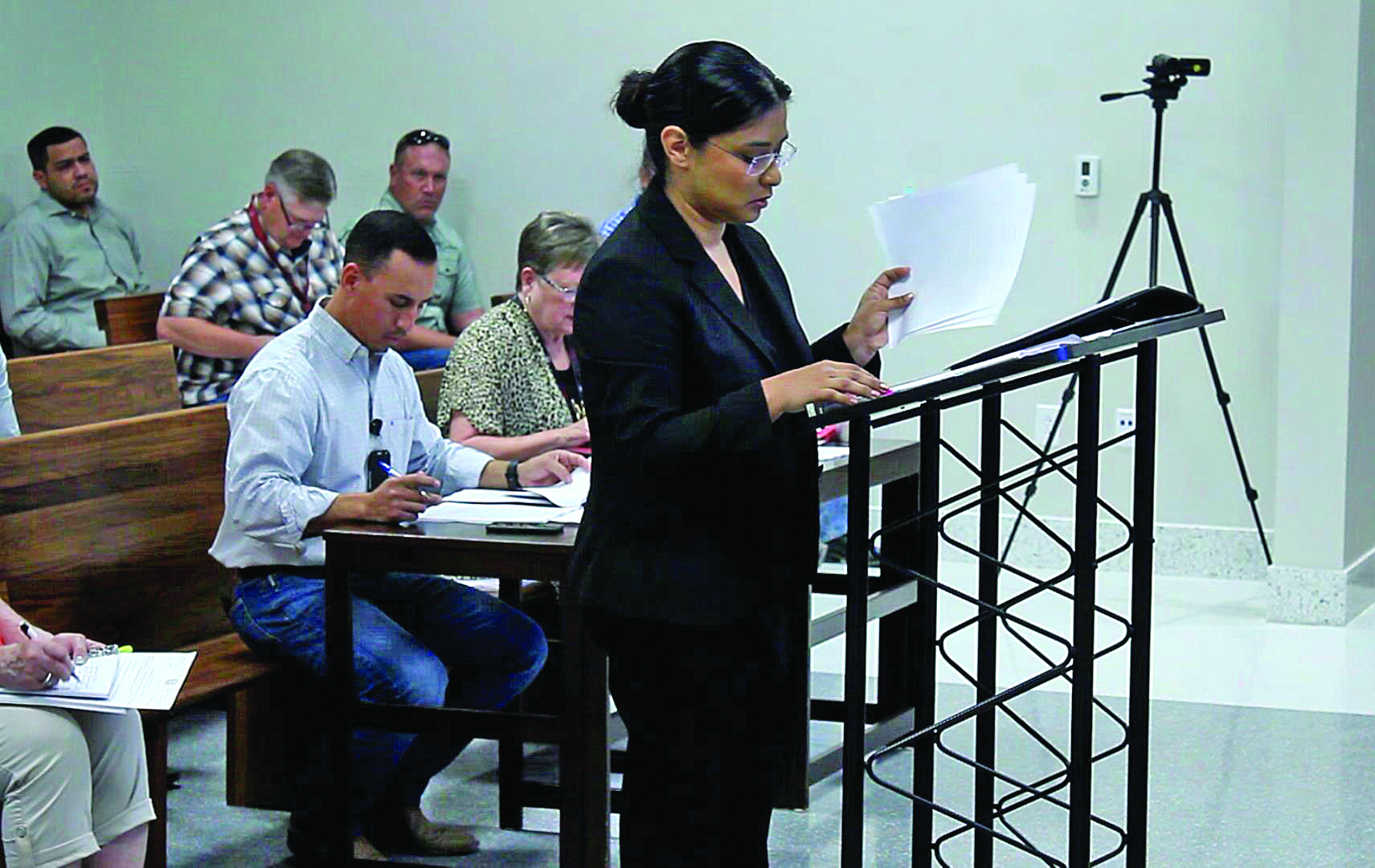
By Anton Riecher An early draft of an outside audit covering the Medina County government for the fiscal year ending September 2021 showed an ending general fund balance of $15,625,413, an increase of $4.3 million over the previous year. Certified Public Accountant Angela Verduzco with Pattillo, Brown & Hill, L.L.P., reported to county commissioners during their May 19 regular meeting. The final audit is due June 30. “The assets and deferred outflows of Medina County exceeded its liabilities and deferred inflows at the close of the most recent fiscal year by $52,270,583,” the draft report states. The county’s overall fund balance stood at $24,187,241, a decrease of $13.5 million from the previous fiscal year, Verduzco said. She attributed the decrease to certificates of obligation issued to cover capital outlay expenditures for the courthouse annex and jail projects. Verduzco directed the commissioners attention to deficits in the balances for three funds – health unit ($36,198), juvenile probation ($48,366) and grants ($46,262). “County anticipates revenues in future periods will eliminate these deficit fund balances, or the County will transfer funds from the General Fund to eliminate these deficits.” The county took in $2.9 million above its anticipated revenues of $23,609,346, the report states. Expenditures were $1.2 million less than the budgeted amount of $1,388,715. “It’s all good news there,” Verduzco said. Income from road and bridge funds represented an increase in the fund balance for all four precincts. Precinct 1 reported $1,819,486, up $337,326, while Precinct 2 reported $2,089,412, up $654,240. Precinct 3 reported $1,018,666, up $371,577, while Precinct 4 reported $1,004,776, up $512,043.
A three-member quorum of the Medina County Commissioners Court voted May 19 to approve the purchase of two bank buildings formerly owned by Community National Bank for $2.1 million and Hondo National Bank for $100,000. The tentative plans discussed are to move the Medina County Tax Assessor’s office into the old Community National Bank. The other Hondo bank was offered as sort of package deal below appraised value, so the county went ahead and purchased that too, though they are unsure what that second building will be used for. Commissioner David Lynch said “some ideas have been kicked around” but nothing has been decided on what the second bank building (HNB) will be used for. One avenue being discussed is allowing area non-profits offering services to have offices in that building On the purchase, County Judge Chris Schuchart stated, “It’s a good deal for us and a good deal for them,” Texas Heritage Bancshares, Inc., parent company of Hondo National Bank, and Medina Community Bancshares, Inc., parent company of Community National Bank, merged operations in 2021. The commissioners voted to authorize Schuchart to execute the purchase contract. Schuchart said his only reservation would be to further negotiate the county’s potential liability under the proposed purchase. Schuhart added that “part of the deal is allowing them (the bank) to use the buildings for 2 years while they are building the new one.”
A $339,000 payment for an elevated tank and other capital expenditures left the East Medina County Special Utility District with just over $2 million in bond proceeds in its account, according to a financial report for April submitted to the board May 17. “We are starting to see a little uptick in our interest rates through across all of our accounts,” business manager Lauren Evans said. “That’s nice because we’ve just been seeing those steadily fall to nothing recently.” Outside of bond proceeds, EMSUD took in $259,692 in revenue in April, Evans said. Expenses for the month totaled $368,224, including the acquisition of Creekwood Ranches Water Supply Corporation. A payment was also made involving a completed project to add 3,300 linear feet of 8-inch PVC water main on U.S. 90 from the Castroville Veterinary Clinic to CR 4612. A second phase of that project is 50 percent complete. EMSUD superintendent Bruce Alexander reported to the board that steel for a tank construction project at Plant 5 in the northwest part of the district has been delivered. “If you’ve ever seen one built it’s pretty interesting how they do it,” Alexander said. However, storage tank and service pump improvement proposed for EMSUD Plant 1 remains on hold waiting for materials, Alexander said. A generator slated to be installed at the recently acquired Creekwood Ranches Water Supply Corporation is not due to leave the factory until the end of May. Also, an application for funding through the U.S. Department of Agriculture to add a generator at EMSUD Plant 6 remains on hold, Alexander said. Problems collecting payments from other water districts in Texas has complicated the issue, he said. Supply chain issues continue to hinder progress on updating EMSUD’s System Control and Data Acquisition system. The project involves using 2-way radio systems to communicate between the various plants and the district’s main office. Legal issues regarding a contested certificate of convenience and necessity (CCN) continued to drag through the Texas Public Utilities Commission. The certificate grants a CCN holder the exclusive rights to provide retail water or sewer utility service to an identified geographic area. In this case, the conflict hinges on an alleged verbal agreement dating back more than 30 years. “The Public Utilities Commission took action (on May 12) to refer the matter to a state hearing,” Alexander told the board. “They are not convinced that the area is ours exclusively because the other party still claims that he had an agreement from 30 years ago.” Editor’s Note: We want to thank the leadership of East Medina, which had generators in place when the historic winter storm hit, ensuring water service when many other entities had water service cut off for days. And for East Medina’s foresight to continue installing generators at various plants to ensure service for any future events. You are one step ahead of the game, and the residents of EMSUD appreciate it! -Kayleen Holder
Purchase of a proposed new home for the Medina County Appraisal District remains locked in litigation nearly 16 months after MCAD contracted to buy the former Hondo office used by the 38th Judicial District of Texas district attorney. The MCAD board of directors took no action following a May 10 executive session on the real estate purchase. “Our current building is owned by the county and we rent from them,” board chairman Tim Hardt said. “As a district we would like to own our own building.” The ownership issue arose in late 2020 after the state authorized Medina County to form its own district court, Hardt said. Prior to establishment the 454th Judicial District Court, Medina County fell under the jurisdiction of the 38th Judicial District of Texas that also included Uvalde and Real counties. MCAD has an earnest money contract to purchase the building in Hondo used by the 38th Judicial District from the three counties involved, Hardt said. However, Christina Mitchell Busbee, the district attorney representing the now reduced 38th, filed suit claiming that the counties lacked the authority to sell the property. “We cannot close on the sale until that litigation is resolved as to who is going to sell the building,” Hardt said. In other business, chief appraiser Johnette Dixon presented proposals for the upcoming 2022-2023 MCAD budget. “The preliminary budget is reflective of an increase in operations and cost-of-living for the employees,” she said. The current 2021-2022 budget for the district is $1,455,700. As a minimum for 2022-2023, the proposed budget is $1,542,025, Dixon said. If the board approves the full cost-of-living salary increase proposed for the district, the final approved budget would be $1,553,725, she said. A final decision on the new budget is expected during the regularly scheduled June 14 MCAD board meeting. “The preliminary budget has to be approved in June,” Dixon said. “The final budget must reach the entities by August for their approval.” A treasurer’s report presented to the board showed that the 12 governmental entities that comprise the appraisal district are on schedule in providing their pro-rated share payments, she said. “Each of the entities pays into a portion of our budget based on their levy,” Dixon said. “We send them quarterly invoices and so far everyone is up to date as of the second quarter.” The May 10 meeting marked the introduction of new board member Clay Bell who replaces Jeff Diles, an eight-year veteran of the appraisal district board of directors. Vice chairwoman Jody Jacobs and county tax collector Melissa Lutz were absent from the meeting.