

One of the most insightful quotations about being blind was made by the infamous blind Helen Keller. She was an author, lecturer, actress, and political activist who was blinded at 19 months of age by a mysterious illness and the first blind woman to get a Bachelor of Arts degree. The movie “The Miracle Worker” told her life story and that of Annie Sullivan who tutored Helen. Her quote is the astounding comment about blindness: “The only thing worse than being blind is having sight but no vision.” What extraordinary vision she had.
Kathleene Runnels, author of Glimpse, is showcasing men and women who “…endured vision impairment but improvised to overcome.” She featured her dad for the first person in the column where she is honoring and recognizing men and women for Blindness Awareness Month. One of her dad’s and mother’s friends was Mary Annis Sikes, who was born blind and later designated legally blind, having also had macular degeneration, detached retina, eye cancer and removal of one eye. However, these issues became stepping stones, not roadblocks.
Like Helen Keller implied, Annis had many visions: graduate from high school, get training, get married, raise her three children (who were 51 weeks apart in age), keep us kids housed, fed, educated, all as a single mother for most of her life.
Annis graduated Brackenridge High School in mid-thirties after overcoming many obstacles and married in 1940. After five years of marriage, there was a divorce. Determined to carry on, she was invited by Van Treese family to stay with them for the better part of a year before moving to government housing. While there, she assisted in house chores, baby sitting the Van Treeses’ two children and helping in any way she could.
Even though she was blind, it was never mentioned to her children. As we got older, we figured out she didn’t have very good vision, but we children never asked about her sight. She did not want pity and was out to prove she could raise the kids. But a few things gave us a clue about her vision as we got older: threading an entire package of needles [for her], reading street signs and grocery prices, watching the cars as she crossed streets. Otherwise, life went on and until she passed away, we never really knew for sure what she could or could not see.
Annis went to Texas School for the Blind in Austin to take a short course to learn how to run a lobby newsstand–also called blind stand, newspaper stand. These businesses gave the visually impaired priority to manage the facilities, which sold drinks, candy, tobacco products (sometimes giving the lobby business the name of cigar stand), newspapers, etc. These businesses were located in lobbies of government buildings, hotels, and commercial buildings, created by The Randolph Shepherd Act of 1936.
Annis’ first lobby stand was in the downtown San Antonio Arsenal, a major army supply depot for World War II (presently H.E.B. headquarters).
Living on the southeast part of San Antonio she rode the city bus to work and back. When coming home, she had all the money from the day’s sales in a cigar box with a rubber band around it. Now comes the ingenious improvisation and a valuable lesson for her daughter, about 10 years old. Annis had her stack money in dollar amounts: four quarters, 20 nickels, etc. Then, the daughter would pick up the coins, tell Annis the denomination, put them back in cigar box. She told her how to write the amount in a column. When all coins were written on the pad, Annis would add the amounts in her head and get the daughter to write them down. Usually, this was done twice to check for accuracy. So, improvisation for the momma, math practice for the daughter. Sadly, she had to give up this career as too many people would steal items from her.
In the interest of improving the housing and neighborhood, the family moved from the government housing to a duplex in the southeast part of town. She took a job with the State Tuberculosis Hospital for a short time, then she transferred to the San Antonio State Hospital where her social worker friend asked for her to be assigned to her as a “housekeeper,” the official job title. Here, she helped Bertha Sperring do all sorts of things: baking cookies for patients at Christmas and wrapping presents, setting up various parties, going to “rich” people’s houses to retrieve donated goods, etc. She helped Mrs. Sperring give parties for Handicapped Club, cooked for church and neighbors.
One more final house move. Annis bought a house converted into a duplex and had permanent income in addition to her state retirement. This brought on another innovation! She had to move all her furnishings. Of course, we never had a car. Mostly, we walked or rode the city bus. This time, the two “grown” sons, around 16 and 17, helped. They had a two-wheel trailer loaded with household furnishings, which they pulled by the tongue, and Annis pushed from behind. It had to be a dire emergency for her to ask for help. The daughter was in college and was only told this story.
The main transportation was a Red Ryder wagon. It was pulled down to the corner grocery store for groceries then hauled up hill a couple blocks loaded with groceries.
When the daughter was in 5th grade and had an ingrown toenail removed, the boys had to pull her in the wagon, up the hill a couple of blocks. The ride home was usually a big shove of the wagon to go downhill, sometimes overturning. But Annis accomplished lots with that wagon and refused to call on people to drive us around.
Wash day was always a trip. The old wringer Maytag was drug out of the shed, filled with water and sorted clothes. Once, the colored clothes had a garment that kept rising out of the hot soapy water. One of the kids told her and she got her broom handle, poked around the garment, which kept coming up. Finally, she took the stick and pulled the garment out: a poor, drenched but still alive kitten was inside that Annis didn’t see.
Annis usually worked two jobs-the state hospital and she worked in the nursery at church on Sundays and Wednesdays. She also did a lot of cooking for the people of Hot Wells Baptist Church, across the street from her house. She was a Charter Member of Hot Wells Baptist Church and was one of two remaining members when the church burned the note. She also babysat neighbor kids.
Annis’ house had swinging doors on it. Many people have lived temporarily with her, kids were always welcome and fed. Often she brought home mental patients for holiday meals. Once, she and Mrs. Sperring hosted 20 University of Mary Hardin-Baylor girls who came to San Antonio for a religious convention.
Another vision Annis had was she determined that all three of her kids would graduate from high school, not exactly smooth sailing with one of the siblings skipping school. She would ride the city bus to the school whenever the principal called. Dreaded event! All three graduated. One son joined the Marines and went to Vietnam, the other was drafted into the Army and went to Korea. They returned home and went to college. Both sons were self-employed as well as having other successful jobs. One graduated, the other lacked only a speech course to graduate, but wouldn’t take it.
The girl graduated and became a teacher. So, another vision accomplished.
Annis had many, many friends. A lot were vision impaired and they often met together and would eat and play dominoes while the young kids played outside till dark. When they went in the house, the grownups were in the dark playing dominoes. The kids would ask permission to turn on lights.
Annis used to say that where there’s a will, there is a way. She definitely had a strong, independent will and always found a way. On about $200.00 a month, she managed to get her three children grown, educated and they all have had rewarding and good lives. They gave her eight grandchildren.
In her last couple of years, Annis moved into a nursing home per her request in McGregor, TX, where she lived until she was a few months shy of 90. She always helped others; she gave sacrificially; she had an outgoing personality, and accomplished many visions. Her oldest grandson Bobby said it best: “To some it seemed she was handed more than her share of adversity. She didn’t seem to notice. Always smiling and always happy. It tells a lot about a person.”
The above story was written by Annis Sikes’ daughter, Portia Sikes McKown, who remains a dear family friend.
Category: The Glimpse
Blindness Awareness Month…A Look at How They Improvised

By Kathleen Runnels
In recognition of Blindness Awareness Month, I want to showcase men and women I know who endured vision impairment but improvised to overcome. Indulge me as I begin with the story of Hubert Van Treese, my father.
As an adolescent, Hubert was playing with a sling shot when the rock ricocheted and permanently put out his left eye. A few years later, he was messing around in the pasture when his friend told him to “look down this pipe,” at which time he shot a rod down it, putting out Hubert’s right eye. I was told he rode home on his horse, with his eye bleeding down his face.
This last injury left Hubert completely blind, and for a year or two his older sister, Vida, became his “eyes.” Vida read all lessons to him, enabling him to remain in school. But when Vida was promoted to high school (This was in Karnes County), Hubert had to leave home and attended The Texas School for the Blind, located in Austin, Texas. (Changed in 1989 to Texas School for the Blind and Vision Impaired). There he learned to read braille and continued his education, which emphasized vocational training and physical exercise, until age 19. By then, Hubert’s vision had returned to the extent of 20/400 in the upper left of his right eye – the second one injured.
As an adult, one job Hubert and many vision-impaired people took back then was working for the San Antonio Lighthouse for the Blind, now known as Vibrant Works, located on Roosevelt Ave. A word about this facility, today they are one of the largest employers of vision impaired individuals in the nation! They are also one of Texas’ largest manufacturers of U.S.-made military apparel as well as providers of independent living skill programs for people of all ages who experience vision loss.
At this job, Hubert made cane-bottom chairs, but another opportunity was presented by the State Commission for the Blind to provide specific job training for blind. In the mid 1940s, Hubert chose a 9-month poultry husbandry vocational course held at Texas A&M. All the men in his class were severely or completely vision impaired, and Hubert became life-long friends with many of them.
Having kept my dad’s text books, certificate of graduation, and photos from his studies there, I recently donated the books and copies of the photos and certification to the university’s Department of Poultry Science. The recipients were thrilled to receive and display these treasures. I feel certain that they are the only artifacts remaining from that program.
So, Hubert finished his poultry husbandry studies and went to work on various chicken farms in Wilson and Gonzales Counties before establishing his own chicken farm south of Somerset in the sandy Black Jack country. He built four chicken houses and worked in that industry until “the bottom fell out of the chicken market,” as I often heard my parents say.
After that, Hubert bought a merchant patrol business in San Antonio, and the family moved first to Southton and later to San Antonio. Hubert continued running that business as a Bexar County Deputy overseeing and patrolling dozens of downtown and outlying businesses until he sold it and retired in 1968. Needless to say, this was before electronic surveillance.
I often wondered how my daddy could function in his role as a deputy when his vision was so severely impaired, yet I know that he was able to compensate, such as working at nights when the sun didn’t exacerbate his vision. And I remember he loved to ride on his riding lawnmower where he often came over to cut our grass (after 1968 my parents lived within a couple miles of us), and he hated pyracantha bushes because he couldn’t see them to avoid the thorns. And he often plowed down first one plant, then another, those that were on his left side because he just couldn’t see them. But he had a shop replete with tools and all sorts of paraphernalia that men keep in their shops, and he had the screws and nails of all different sizes in little jars and all he had to do was reach for whichever jar for whatever size screw he needed. And if my brother used a tool and didn’t replace it exactly where it was supposed to be, it was not a happy picture! Or if he moved a jar of screws!
Hubert loved to be around people. He was an avid “42” player, holding all seven dominoes close to his face in one big hand and laughing heartily at a good play. Another pastime was his love of music. Hubert played both the guitar and mandolin in a western band while in his 20s, and he continued to strum with his good friend who sang along in those old western songs.
And he was a bowler, continuing to participate in a couples bowling league into his late 50s. He used a two-step, hop approach because he struggled all his adult life with a leg injury incurred at age 20 from a car wreck, leaving him with 73 broken bones and months to recover!
Needless to say, Hubert experienced more than his share of injuries; yet, through it all, he never complained. He was not self-pitying, even known to laugh at himself when he made a blunder because of his near blindness. He did love to laugh and always maintained a cheerful attitude! And, as the oldest man in his extended family, Hubert was the one that family members came to for help, like a place to live temporarily or for a financial boost. He took care of anyone who needed help. No, Hubert’s “handicap” did not keep him from enjoying a happy life and being a positive inspiration to others.
HUBERT VAN TREESE could laugh at his own blunders
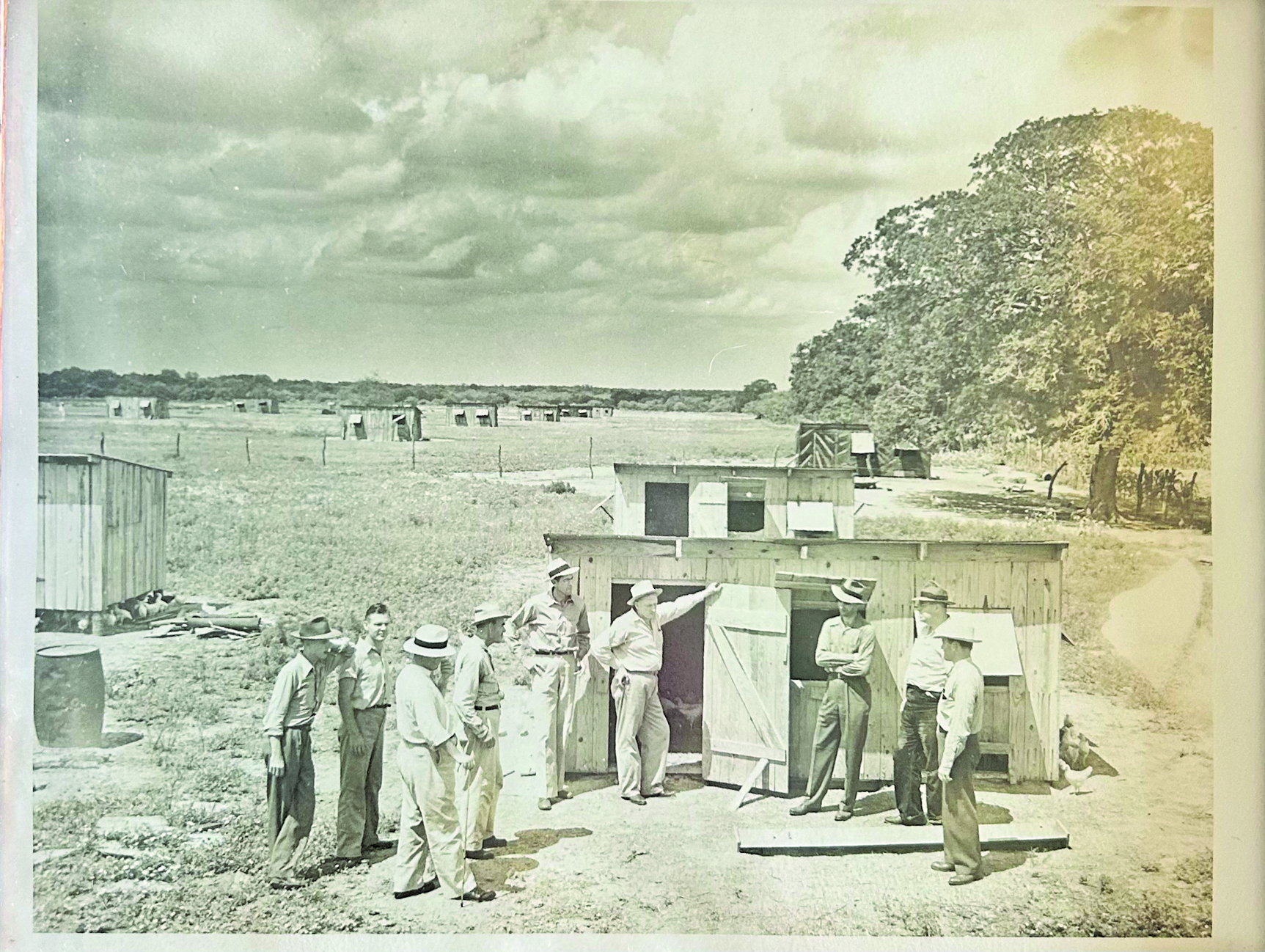
Hubert Van Treese standing at the door of a chicken house at College Station during his poultry husbandry course. His photos and books have been donated to the poultry husbandry Museum at Texas A&M.
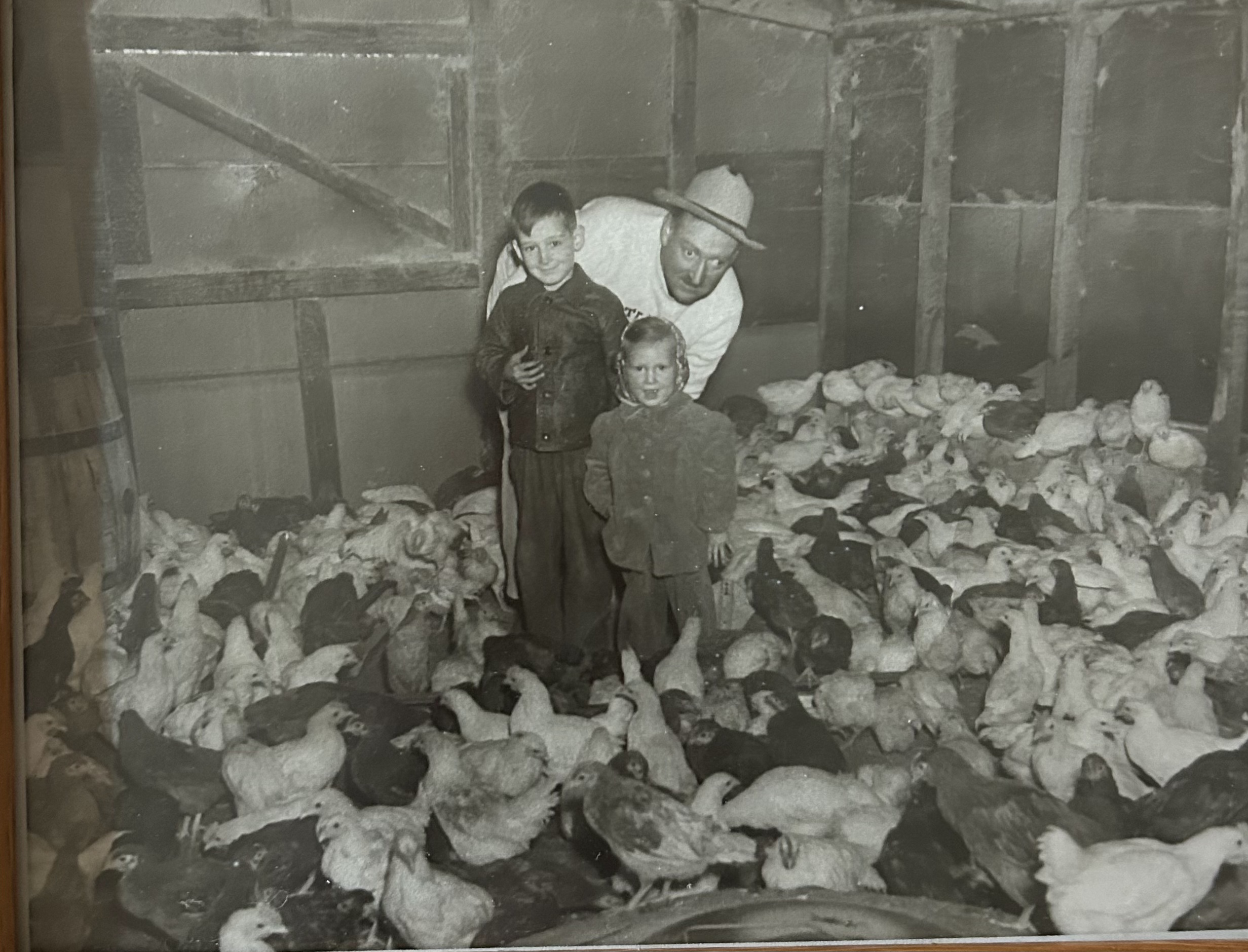
Hubert VanTresse in one of his chicken houses with his two children Travis and Kathleene.
Christmas Gift!

It’s a miracle that this Briscoe Family Christmas Tradition has carried on because it is an odd one and a little awkward to convey! I’ll begin with its origin.
My grandfather, Mary Briscoe’s dad, was a young man during the depression. There were very few funds for gifts or “extras” during Christmas, so a game was invented to play instead and he brought this tradition to us. On the morning of Christmas Eve, family members would race to be the first to say “Christmas Eve Gift” to each person in the house.
The name of the person must be said after “Christmas Eve Gift” to be fully official. If you were “gotten,” you’d vow to “get” them the next time and say things like “you cheated,” “hey, I haven’t even had my coffee yet” or “that’s not fair!” Then, the same game would be played on Christmas morning.
“Christmas Gift, Dad!”
You might imagine that when a new person was added to the family, much explanation and encouragement to play the game was sometimes necessary. At this point, the new family member was probably saying, “Who are these people?” But, by some miracle, the game is played with competitive enthusiasm by the new comers as well.
With family members flung far and wide and texting options available, it’s a given that family in Arizona, California, or the Yukon Territory are typically not the winners of the game because of the time differences. Hey, it’s not my fault that they moved to a time zone that is two hours behind!
This silly game has a deeper meaning for me now. There’s someone else who has “gotten” all of us first, Emmanuel, Lord of Lords! We love because He first loved us. So, if a more awake person happens to “Christmas Gift” me, I’m pretty OK that they loved me first.
[Here’s hoping everyone had a] Merry Christmas, and know that we have been “gifted” first with the most precious gift of all.
Shook School was one of four area rural schools

Rural schools were a way of life in the first half of the 20th century. In Medina County, according to a Devine News publication on July 18, 1902, there were 19 school districts, and 33 in 1926-27. Here’s the interesting list of the 19 in 1902: Castroville, San Geronimo, Lacoste, Quihi, Hondo, D’Hanis, Haass, Chicon, Francisco, Lower Hondo, Black Creek, Community, Rear Crock, Devine, Tehencuna, Deer Creek, Leinweber, Maverick, Coal Mine, totaling 2140 students.
Later, the school “districts,” as they were called, that fed Devine Schools were Biry, Shook, Big Foot, and Black Creek. In around 1952, those rural schools that served the surrounding communities and consisted of first-sixth grades were closed. Up until that time, students attended DISD for their remaining years, but once the rural schools were closed, students from Big Foot, Biry, Black Creek and Shook attended Devine schools for all grades.
A little history of the Shook rural school has been shared by Bob Bendele. Not only did he attend Shook, but so did his father, his mother, and his maternal grandmother. But when Bob was in the second grade, this school and others across the county were closed.
The school consisted of three rooms and six grades. Picture a rectangular building with one room on each side, a hallway down the middle, and a larger room extending at the back. Facing the building, students in first-third grades attended class in the left room; students fourth -sixth attended in the right room. Each room had only one teacher. The back room served as an auditorium with a stage at the back. Bob says many performances happened there as well as community events.
The entrance to the school building had a porch with a bell tower above it. It was actually a very attractive school house, and at the time Bob attended, there were 29 total students.
Other interesting features Bob Bendele shared was that there was a garden that once was used as a mule pen. There was a windmill with a cypress water tank. And there was also a building that had been a teacher’s residence at one time. West of the school house was an outhouse and a baseball diamond, which Bob says was beat down hard from bare feet and drought. Today, the slab where the porch stood remains, and nearby there is a historical marker. The location is near the corner of Hwy 1343 and Calame Store Road (C.R. 664), all which was once Keller property.
Rather than being demolished or left to decay, the Shook school building was moved to Devine and situated at the football field to be used for many years (until 1964) as a field house. The left side was used as concession stand – with the upper part of the wall removed to accommodate customers – and the right side was used as a visitors and B-Team dressing room. The former auditorium was used as the varsity dressing room and the former stage became the coaches’ office. Unfortunately, the bell tower was not moved or saved. And few of these historic school buildings across the state were saved, which is such a shame. But we can share and thus save the stories.
Southton School one of many rural schools

Southton School, one of many rural school buildings that history has forgotten.
Until the early 50s, there were hundreds of rural community schools across Texas. One such elementary school was located in Southton, Texas, a few miles off Highway 87 and Hilltop toward Floresville. I have sweet memories of attending second grade there. The school consisted of three rooms with two grades and one teacher to each room. The first graders were on one end of our room and the second graders on the other. Our teacher sat at the back corner of the room. Her name was Mrs. Williams. I well recall so many happy times there including friends who still live in my memory, even though I have seen few of them since elementary school. One friend was Terry who sat next to me.
Terry was a talker, and so am I, but I’m also a rule follower. So one time when the teacher admonished us not to talk and anyone who did would get a spanking, Terry started talking to me and I told him to hush and I got caught. Sometimes we just get in trouble when it’s not our fault.
I also recall being awarded the distinction of best reader! Go figure. That brings to mind a wonderful memory of the mobile library. That was so exciting and, Oh, what a joy it was to walk down the aisle in that portable library in awe as I took in the smell of the books and made my choices. My favorite books were about ballet and horses.
I walked or rode my bike to school every day. It was about a mile from our home. On more than one occasion, my big, beautiful, white dog, Butterball, would follow me, and I would have to coax him back home. But generally, I did not ride or walk alone. Several neighborhood children also walked and rode their bikes to school. One of my classmates who rode her bike alongside me was named Margie, a neighbor and such a good friend.
Another fond memory of living at Southton was the post office. It was around the corner from the school and sometimes after school I would go there to pick up our mail. The post office consisted of a regular house, and when you walked up onto the porch and you faced the front door, to the left was another door which had been converted to a window where the clerk/homeowner would hand you your mail.
After second grade, that school was closed like so many others across the state, and the building, unfortunately from a historical viewpoint, was torn down. A new school house named Harmony, which was just off of Highway 87 east of Hilltop, became the new, up-to-date, modern elementary school. I attended Harmony third through sixth grades.
East Central ISD encompasses 296 square miles. When I attended Harmony in third through sixth grades, I rode the bus for 5 miles from home. Then in seventh grade, I attended Oak Crest, which was an hour from Harmony. So I rode the bus from my house to Harmony where I changed buses and rode from Harmony to Oakcrest. It was quite a trip.
Oakcrest was a new building situated across the street from East Central High School. As I recall, it had four rooms, two for 7th and two for 8th grades. The principal was one of my teachers. A fun fact is for lunchtime all students boarded a school bus and we rode across the road – Sulphur Springs Highway – to the East Central high school cafeteria. At the end of lunch, we all piled back in the bus and rode back across the road.
Today, Oak Crest is an elementary school with an enrollment of around 680 students. Because we moved to San Antonio near the end of my seventh-grade year, I left Oak Crest and my humble rural school to attend Burbank, which was a 4A high school, equivalent to today’s 5A. The junior high was on the same campus as the high school, which made for an even larger population. Talk about culture shock. Yet, I like to think that I experienced the best of two worlds, small country schools as a child and big city school as a teen.
In keeping with this rural school theme, stay tuned next week to learn about Medina County’s Shook school.
Lazarus, the reborn chicken

By Kathleene Runnels
I’ve always loved chickens. It goes back to my daddy’s having been a chicken farmer raising White Leghorns when I was little. At the time of this incident, we had a nice flock of a variety of hens and a shiny black rooster that we called Blacky. So, when I was gifted a white Brahman rooster, I was quick to make him a home with my 20+ hens. Knowing that one rooster per up to 10 hens is ideal, I saw no issue in bringing another rooster into the flock.
I was wrong. On any given day these two fought like fighting cocks, very much to my distress. One day, apparently there had been a vicious fight as Blacky was barely standing alone in the barn with his feathers all fluffed out and eyes not even open. Surely, we thought, he was about to die. He did not. He recovered!
Blacky was resilient and must have been filled with resolve, because a few days later Franklin and I arrived home to find Whitey dead-dog-dead with his legs straight out stiff and naturally not moving. That was so sad. So, needing to humanely dispose of Whitey, Franklin got an empty feed sack, tossed the dead Whitey inside, tied the ends with string, and hauled him out to the back pasture. The dirty job was done.
But wait. There’s more. The next day Franklin hollered for me to come help him because apparently Whitey was NOT dead. Franklin saw him running around near the place where he had been summarily dumped. What?
So, I got a pet carrier, stuffed some hay inside, and prepared to nurse Whitey back to health. (I’ve even been known to take a rooster to the vet!) The two of us rode out in the Mule where I easily picked up the poor thing, held him in my arms to settle him, and when we got back to the house I put him in the above-mentioned pet carrier with food and water for him to recuperate from his ordeal. After just a couple of days, Whitey was ready for his freedom, and I turned him out where he was quickly accepted back to “his” flock. You know, a rooster has his own hens.
As for Blacky, I soon found him a rescue home, so Whitey then had the entire flock to himself. And that’s where his name was changed to Lazarus. Don’t you think that’s fitting?
Today, I have another white rooster, a White Leghorn, and in homage to my daddy, I named him Hubert, my dad’s name!
Elvis is Still the King of Rock ‘n Roll!

By Kathleene Runnels
For the umpteenth time I recently watched “Elvis – Aloha from Hawaii”. Whether or not you’re a fan – and why on earth would you not be – Elvis was a quintessential entertainer! Engaging with the audience, melting your heart when looking straight into the camera, performing with powerful energy, and just breath-taking to look at!
That live performance was done in 1973, and Yes, I watched it live. But in addition, my friend, Sharon Vetters Dunnam, and I went to see him live in San Antonio at the original convention center on three occasions! Yep. Three times I had the pleasure to see Elvis live! His performances were exactly like what you see on his satellite show. My only regret was that I always took my binoculars and Sharon did not (!), so I had to share! That’s what you call real friendship!
Looking back to Elvis’ beginnings, I was 12 when I saw him on our black and white TV while living in Southtown, Texas, as he performed on the Tommy and Jimmy Dorsey show. He sang “Heartbreak Hotel”, and at the end he bowed so low his hair almost touched the ground. I told my mother that this guy would be famous some day, and I went to the desk and wrote down his name. Later I heard that a girl from our high school, East Central, took a razor blade to cut his name into her thighs and pour ink into the cuts! I guess that’s the old-school way of tattooing! But rest assured, I’m not that much of a fanatic!
Now Elvis’ movies never appealed to me except for “King Creole”. I have that on VCR and I do watch it from time to time. I love the score in that movie. But as for his singing, I have every album Elvis made, and more importantly, I have every 45 rpm! When a new 45 would come out, I would hurry down to Sears on SW Military Dr and go to their record department and purchase my copy. Do I ever listen to them? Yes, I do. I actually have the “Stereo” that my dad gave me for my 16th birthday.
So, it’s August, and August marks the 48th anniversary of Elvis’ death at the untimely age of 42. My dad called me to break the news. I well recall that when his mother died at that same age, Elvis said he would not live past 42. Interesting. To think that he’s been dead longer than he lived. But boy, Sirius FM channel 79 sure does keep him “alive” as well as the amazing exhibits at Graceland. All of the exhibit buildings display fascinating memorabilia, not just the mansion, which today seems ordinary, but in its day was just that.
Listening to Elvis takes me back to those impressionable (and mostly enjoyable) high school years, and his music always touches me, whether it’s from his first recordings or his later ones, like “Just Pretend”. I only wish there had been more live performances recorded.
So, here’s to all you Elvis fans, those of my generation and younger!
Freeman White, Final Remembrance

Freeman White was born on March 19, 1930, and passed away on November 24, 2024. His lovely wife of 66 years, Wilma, preceded him in death on September 9, 2021. Freeman’s legacy as a Purple Heart recipient is an appropriate story to retell, as this is the season for the Wreaths Across America event.
LINAY RUNNELS WILLIAMS

Chosen as a 2025 WRANGLER “COWGIRL 30 UNDER 30”
Being chosen as a member of WRANGLER’S “The COWGIRL 30 UNDER 30 CLASS OF 2025” is a prestigious accomplishment. WRANGLER COWGIRL magazine seeks outstanding young women from around all America to feature as “trailblazers who open doors for others, share their enthusiasm, and embody the qualities that keep the Western industry thriving.”
SANDY TEGELER BOWYER used her graduation money to stay in the jungles of Ecuador

In our days, only the rich could go to kindergarten. With me being the third of six kids, I didn’t really know what kids today know when they enter first grade. To learn to count, the teacher had us go around and count each desk! I believe there were 32 desks in our first grade room!
We took packed lunches because back then my elementary school had no cafeteria. We had three recesses a day – half an hour mid morning and mid afternoon and an hour after lunch. We enjoyed jump rope, hop scotch, hoola-hoop, while the boys enjoyed playing marbles, etc.
Each morning we said the pledge to the flag and sang My Country Tis of Thee. And we prayed. Before eating lunch, we all said a prayer together. “God is Great, God is Good, and we thank Him for our food, Amen”
In the third grade, I was chosen to be the queen of my class. My mom borrowed a fancy pink dress for me to wear. The boy who was my escort… lol the king… kicked me real hard.. lol. So I was kicked by a king. Also while I was in the third grade God kept impressing on my heart that He wanted me to commit my life to becoming a missionary and to go to a country where the Gospel had never been taught. I struggled with that decision because I was so young. After three days of not being able to concentrate on my math, I finally said yes to God. This decision helped me so much during my life because it gave me focus, and I knew that I had to only marry someone who was also committed to be a missionary, or I would stay single.
Continue reading “SANDY TEGELER BOWYER used her graduation money to stay in the jungles of Ecuador”