

N. B. “Jack” Sikes. It was an accident with lye that caused his blindness.
N. B. “Jack” Sikes, as he was known in later life, was totally blind, but he told his older daughter, Carole, that the epitome of his philosophy of life, was “Joy in Life.” And he did live it in a big way. A disability can make one bitter or better.
According to Sikes, he lost his sight in an accident at age two or three. Playing in the garage, he spilled lye, which blinded him in both eyes. He went through many medical treatments, including the removal of both eyes, while attending The Blind School in Austin and received prosthetic eyes. This tragic event, too, led to having joy, initiative, ambition, and a high work ethic. He achieved many successes among some trials, and he had so many wonderful life experiences, occupations; but, he said above all else, he “desired understanding that is not construed as sympathy.” His description of “understanding” is perhaps monumental sighted as well as blind.
As N. B. said, “Understanding is the state between persons wherein one may know the other’s moods, feelings and a condition of truly plumbing the emotional depths, each of the other. I have overcome the so-called handicap of blindness insofar as earning a living, making friends, even influencing people. But a blind prson is denied that contact of vision, which is the basic intercourse between all humans and even animals [he had several trained guide dogs, which he had to train with them]. Because while I am thinking one thing, I cannot see the emotion or attention that is mirrored in a person’s eyes, and that is sort of like always feeling that I do not have their full attention (they could be reading a magazine, looking out the window, etc.) Just that lack of being able to look into a face and see therein whatsoever may be there shown, has cost me dearly in all walks of life. I am not bitter. I feel in all things, I must do a little more–a compensating technique, as it is known, psychologically.”
Bitter Sikes was not. He graduated from The School for the Blind in Austin with an emphasis on a vocational education and Austin High School in 1938 where he took needed requirements to get into college. He finished University of Texas in Law and Business Administration, patented a metal folding ironing board sold by Sears, and ironed his own clothes on that board. Later, he bought a couple of mattress factories where he stuffed and sewed mattresses with his mother and a couple employees. He was a self-proclaimed “Fix It” man, who repaired his own appliances, car, neighbors’ items. For awhile, he had his own cabinet shop.
Then, Sikes went to work for Texas State Commission for the Blind as a placement counselor, then he said he got the wunderlust and went to Detroit as a public relations manager for Pathfinder and moved to Canada later to work as a diesel machinist. He reaturned to Austin and was district manager for the Lanier Company who sold office equipment.
Here he was awarded the Distinguished Salesman Award.
Reporting became Sikes’ first love after being certified as a court reporter in Austin. He loved the investigation of crime scenes, trials, interviewing, etc. Eventually, he was appointed Federal Court Reporter for the Austin district. His wife, Jerry, would type all the documents, then he would bind them and present to officials and lawyers.
Sikes pursued the court reporting career until his untimely death on his birthday December 24, 1961, when he and his wife perished in their house that caught fire in the middle of the night.
As a family man, he had one daughter, Carole Sikes Boyce with his first wife, then with Mary Annis Sikes, his second wife, he had Portia Sikes, McKown, Elgynn Derek Sikes and Mark Stanton. He and wife Jerry did not have children, but she had two daughters.
Sikes loved life, camping, playing the guitar, working, and his family. A Jack-of-All Trades, inventor, mattress maker, cabinet shop, salesman, trainer of Weimer Runners for Blind, court reporter, son, father, husband, philospher…a man for all seasons who was an overcomer and overachiever, who never became bitter because of his blindness, rather he always found that “Joy in Life.”
This article is told by N. B. Sikes’ daughter, Portia McKown Sikes, both of whose parents were vision impaired.
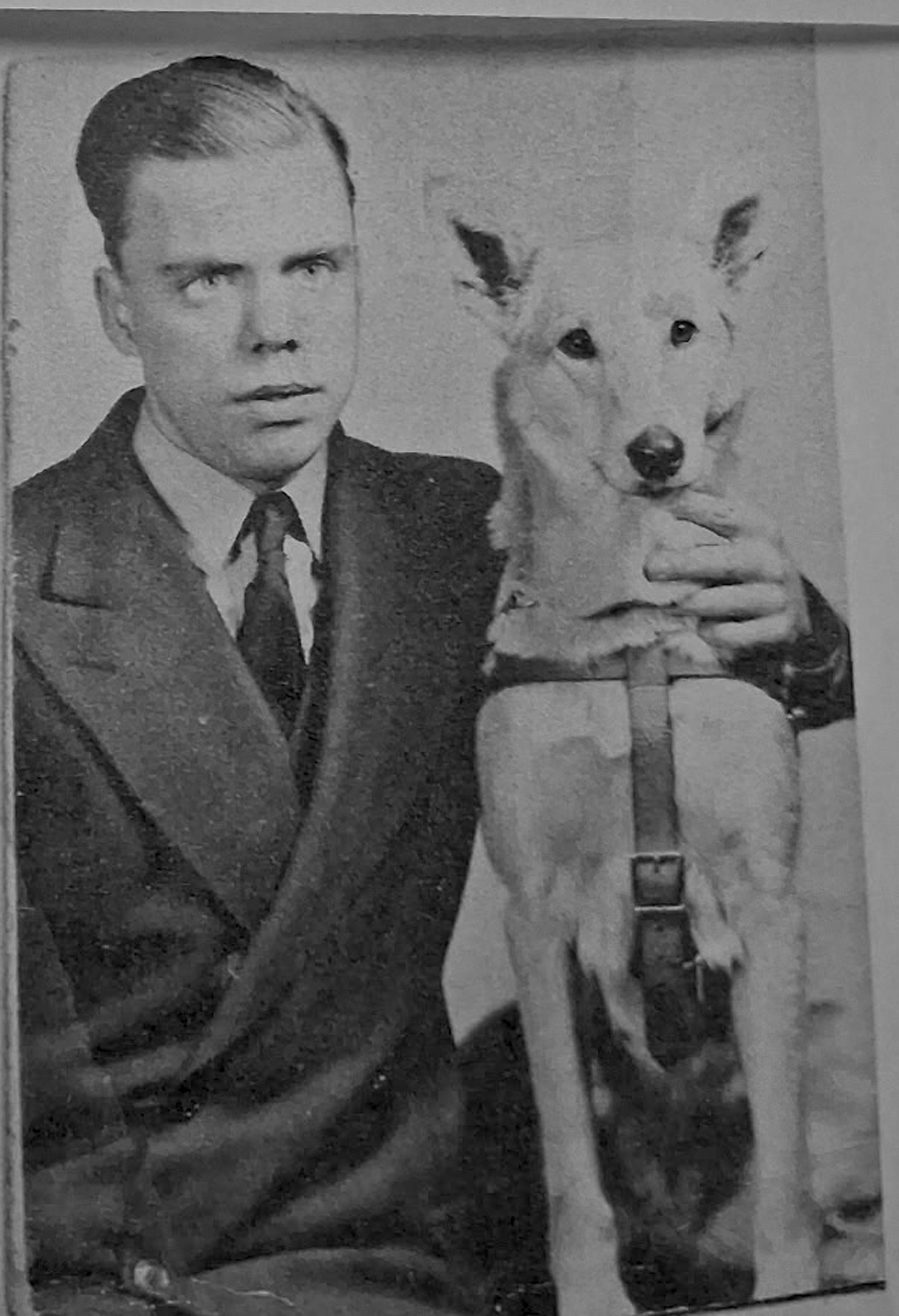
Pictured are N. B. and his guide dog, Ladeen.