

By Kathleen Runnels
In recognition of Blindness Awareness Month, I want to showcase men and women I know who endured vision impairment but improvised to overcome. Indulge me as I begin with the story of Hubert Van Treese, my father.
As an adolescent, Hubert was playing with a sling shot when the rock ricocheted and permanently put out his left eye. A few years later, he was messing around in the pasture when his friend told him to “look down this pipe,” at which time he shot a rod down it, putting out Hubert’s right eye. I was told he rode home on his horse, with his eye bleeding down his face.
This last injury left Hubert completely blind, and for a year or two his older sister, Vida, became his “eyes.” Vida read all lessons to him, enabling him to remain in school. But when Vida was promoted to high school (This was in Karnes County), Hubert had to leave home and attended The Texas School for the Blind, located in Austin, Texas. (Changed in 1989 to Texas School for the Blind and Vision Impaired). There he learned to read braille and continued his education, which emphasized vocational training and physical exercise, until age 19. By then, Hubert’s vision had returned to the extent of 20/400 in the upper left of his right eye – the second one injured.
As an adult, one job Hubert and many vision-impaired people took back then was working for the San Antonio Lighthouse for the Blind, now known as Vibrant Works, located on Roosevelt Ave. A word about this facility, today they are one of the largest employers of vision impaired individuals in the nation! They are also one of Texas’ largest manufacturers of U.S.-made military apparel as well as providers of independent living skill programs for people of all ages who experience vision loss.
At this job, Hubert made cane-bottom chairs, but another opportunity was presented by the State Commission for the Blind to provide specific job training for blind. In the mid 1940s, Hubert chose a 9-month poultry husbandry vocational course held at Texas A&M. All the men in his class were severely or completely vision impaired, and Hubert became life-long friends with many of them.
Having kept my dad’s text books, certificate of graduation, and photos from his studies there, I recently donated the books and copies of the photos and certification to the university’s Department of Poultry Science. The recipients were thrilled to receive and display these treasures. I feel certain that they are the only artifacts remaining from that program.
So, Hubert finished his poultry husbandry studies and went to work on various chicken farms in Wilson and Gonzales Counties before establishing his own chicken farm south of Somerset in the sandy Black Jack country. He built four chicken houses and worked in that industry until “the bottom fell out of the chicken market,” as I often heard my parents say.
After that, Hubert bought a merchant patrol business in San Antonio, and the family moved first to Southton and later to San Antonio. Hubert continued running that business as a Bexar County Deputy overseeing and patrolling dozens of downtown and outlying businesses until he sold it and retired in 1968. Needless to say, this was before electronic surveillance.
I often wondered how my daddy could function in his role as a deputy when his vision was so severely impaired, yet I know that he was able to compensate, such as working at nights when the sun didn’t exacerbate his vision. And I remember he loved to ride on his riding lawnmower where he often came over to cut our grass (after 1968 my parents lived within a couple miles of us), and he hated pyracantha bushes because he couldn’t see them to avoid the thorns. And he often plowed down first one plant, then another, those that were on his left side because he just couldn’t see them. But he had a shop replete with tools and all sorts of paraphernalia that men keep in their shops, and he had the screws and nails of all different sizes in little jars and all he had to do was reach for whichever jar for whatever size screw he needed. And if my brother used a tool and didn’t replace it exactly where it was supposed to be, it was not a happy picture! Or if he moved a jar of screws!
Hubert loved to be around people. He was an avid “42” player, holding all seven dominoes close to his face in one big hand and laughing heartily at a good play. Another pastime was his love of music. Hubert played both the guitar and mandolin in a western band while in his 20s, and he continued to strum with his good friend who sang along in those old western songs.
And he was a bowler, continuing to participate in a couples bowling league into his late 50s. He used a two-step, hop approach because he struggled all his adult life with a leg injury incurred at age 20 from a car wreck, leaving him with 73 broken bones and months to recover!
Needless to say, Hubert experienced more than his share of injuries; yet, through it all, he never complained. He was not self-pitying, even known to laugh at himself when he made a blunder because of his near blindness. He did love to laugh and always maintained a cheerful attitude! And, as the oldest man in his extended family, Hubert was the one that family members came to for help, like a place to live temporarily or for a financial boost. He took care of anyone who needed help. No, Hubert’s “handicap” did not keep him from enjoying a happy life and being a positive inspiration to others.
HUBERT VAN TREESE could laugh at his own blunders
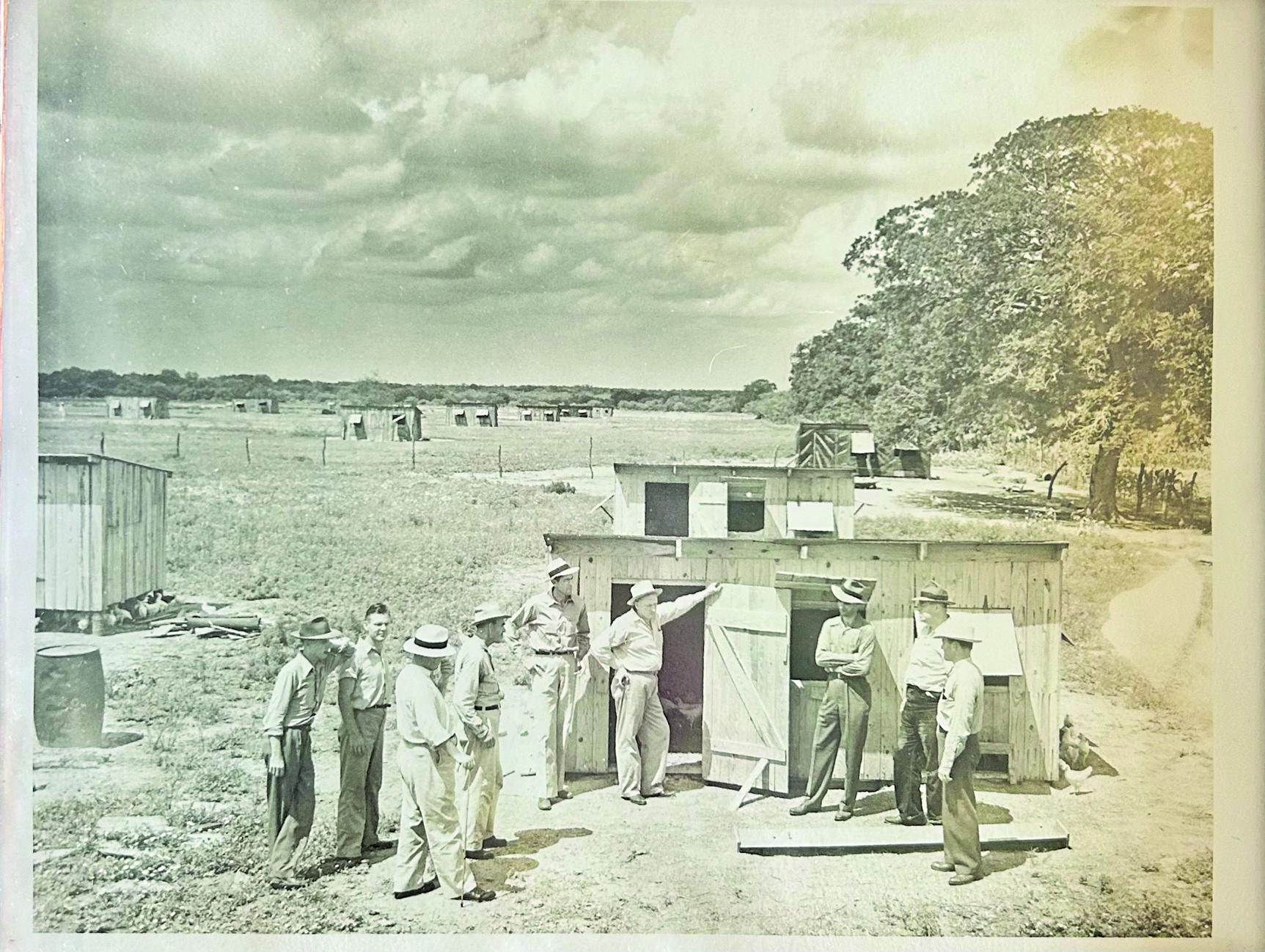
Hubert Van Treese standing at the door of a chicken house at College Station during his poultry husbandry course. His photos and books have been donated to the poultry husbandry Museum at Texas A&M.
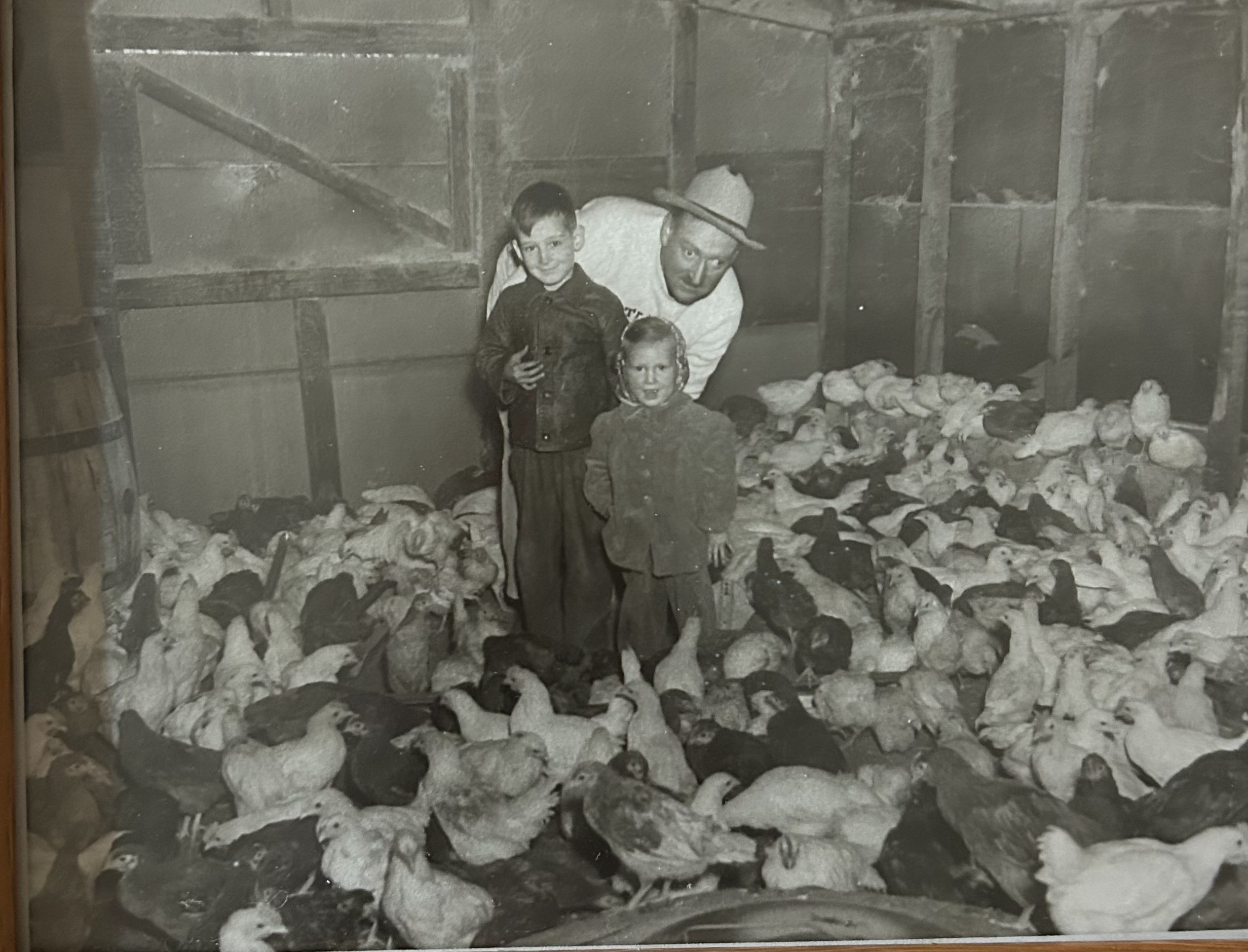
Hubert VanTresse in one of his chicken houses with his two children Travis and Kathleene.